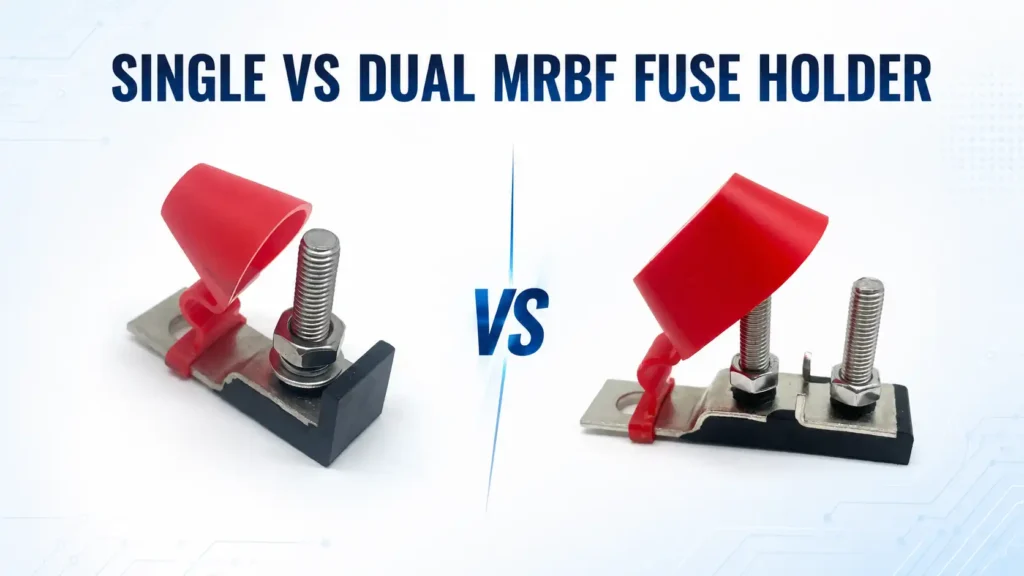
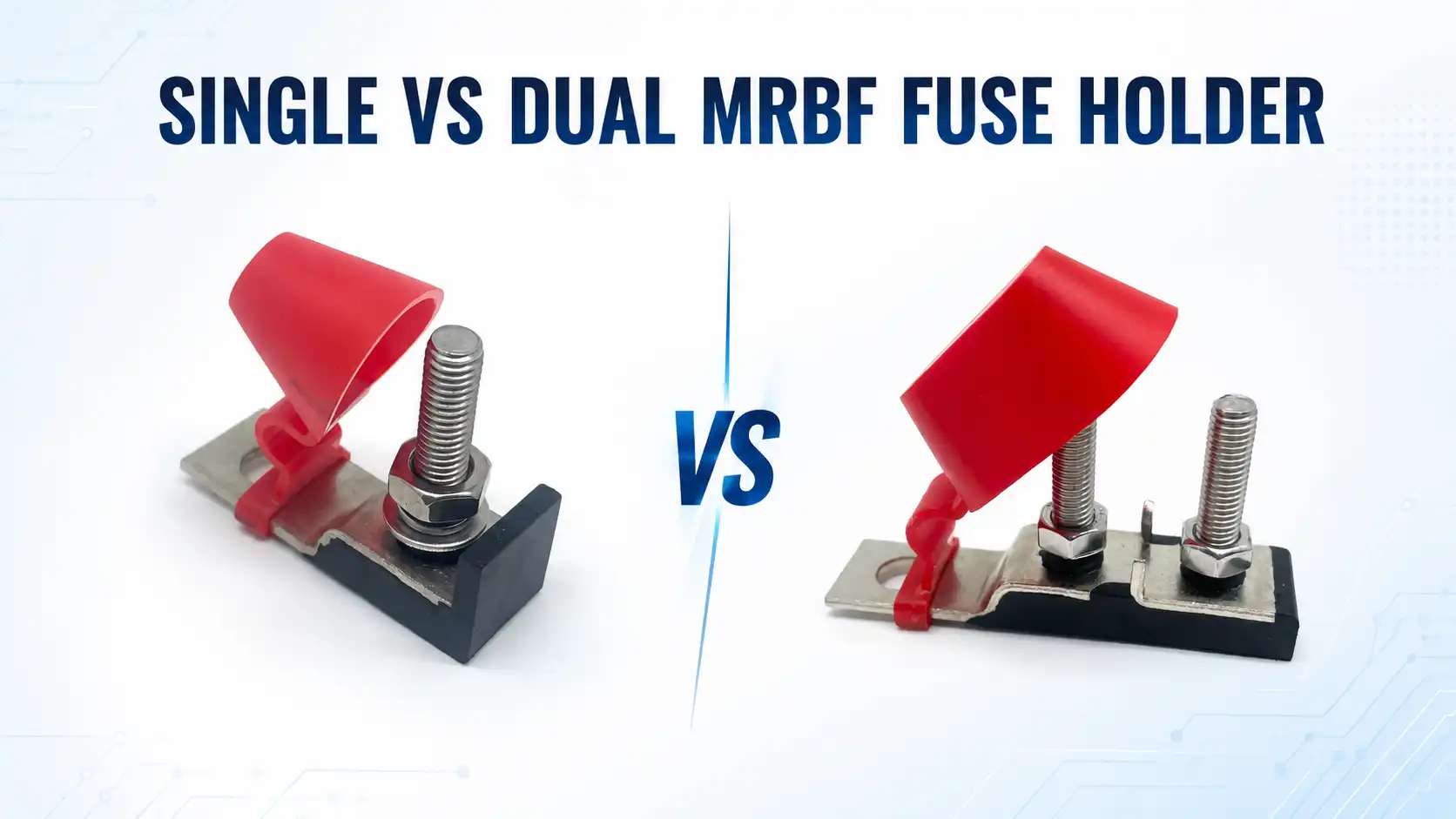
Choosing between a single and dual MRBF fuse holder is mainly a question of how many circuits need independent fuse protection.
A single MRBF fuse holder provides one fuse position for one protected high-current branch circuit. A dual MRBF fuse holder provides two fuse positions, allowing two separate branch circuits to be protected from one compact distribution point.
However, choosing a dual holder does not automatically mean that the system can carry twice the current. Voltage rating, total holder current capability, fuse rating, conductor ampacity, connection quality and installation conditions must still be evaluated separately.
If you are new to this fuse format, start with our MRBF Fuse Holder Guide before comparing the two configurations.
Quick Answer: Single vs Dual MRBF Fuse Holder
When comparing a single vs dual MRBF fuse holder, the main difference is the number of independently protected circuits.
A dual MRBF fuse holder is useful when two separate circuits need individual fuses close to the same battery or power-distribution point.
The main difference is therefore circuit count, not simply current capacity.
| Feature | Single MRBF Fuse Holder | Dual MRBF Fuse Holder |
|---|---|---|
| Fuse positions | 1 | 2 |
| Protected branches | 1 | 2 |
| Typical purpose | Protect one high-current circuit | Protect two independent circuits |
| Wiring layout | Simpler | More compact for two branches |
| Fuse ratings | Selected for the individual circuit | Each fuse selected for its own branch |
| Holder current limit | Must follow holder specification | Total holder limit must also be checked |
| Best suited for | One main load or branch | Two separately fused loads |
What Is a Single MRBF Fuse Holder?
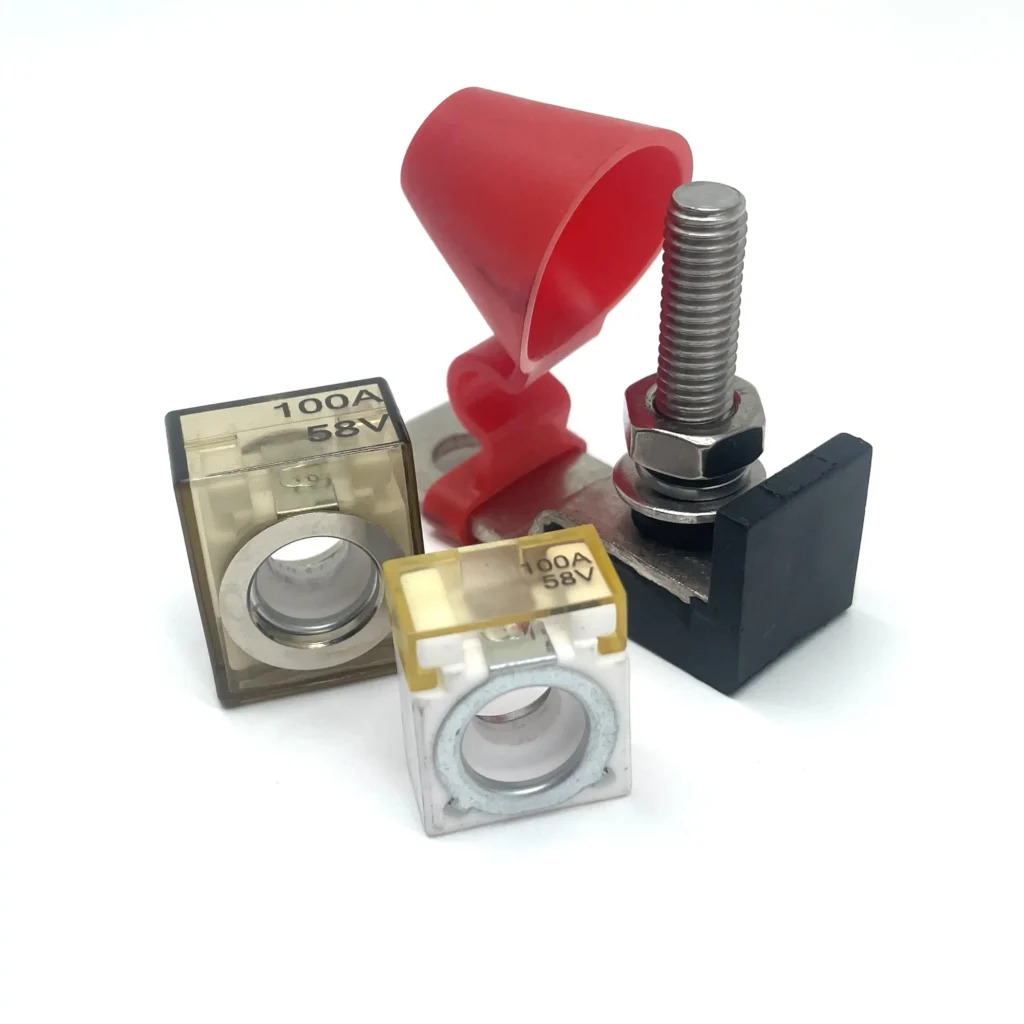
A single MRBF fuse holder contains one fuse mounting position and is intended to provide a compact connection point between the power source and one protected branch.
Typical examples may include:
- one inverter feed;
- one auxiliary distribution feed;
- one high-current accessory circuit;
- one battery-fed DC branch.
The design is straightforward because there is only one fuse position and one protected output path.
For applications requiring only one branch, using a single holder also avoids adding an unnecessary second fuse position.
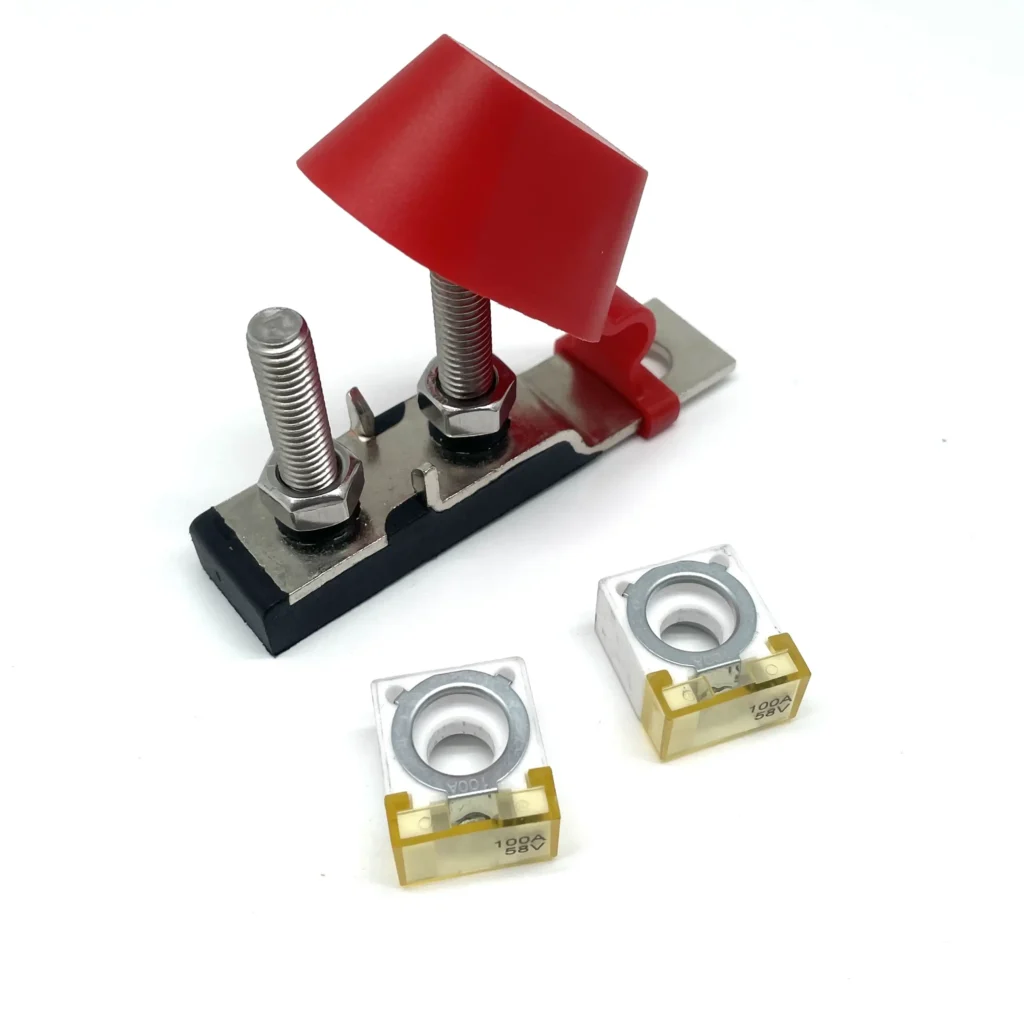
Cozy Single MRBF Fuse Holder
The Cozy CZY-FH04 Single MRBF Fuse Holder is designed for one MRBF fuse position and uses an M8 stud connection.
Known Cozy specifications include:
- 1 fuse position;
- 58V DC application voltage;
- maximum application current up to 300A;
- M8 stud;
- PBS body;
- nickel-plated copper current-carrying plate;
- stainless-steel stud and nut;
- protective cover;
- waterproof holder design.
What Is a Dual MRBF Fuse Holder?
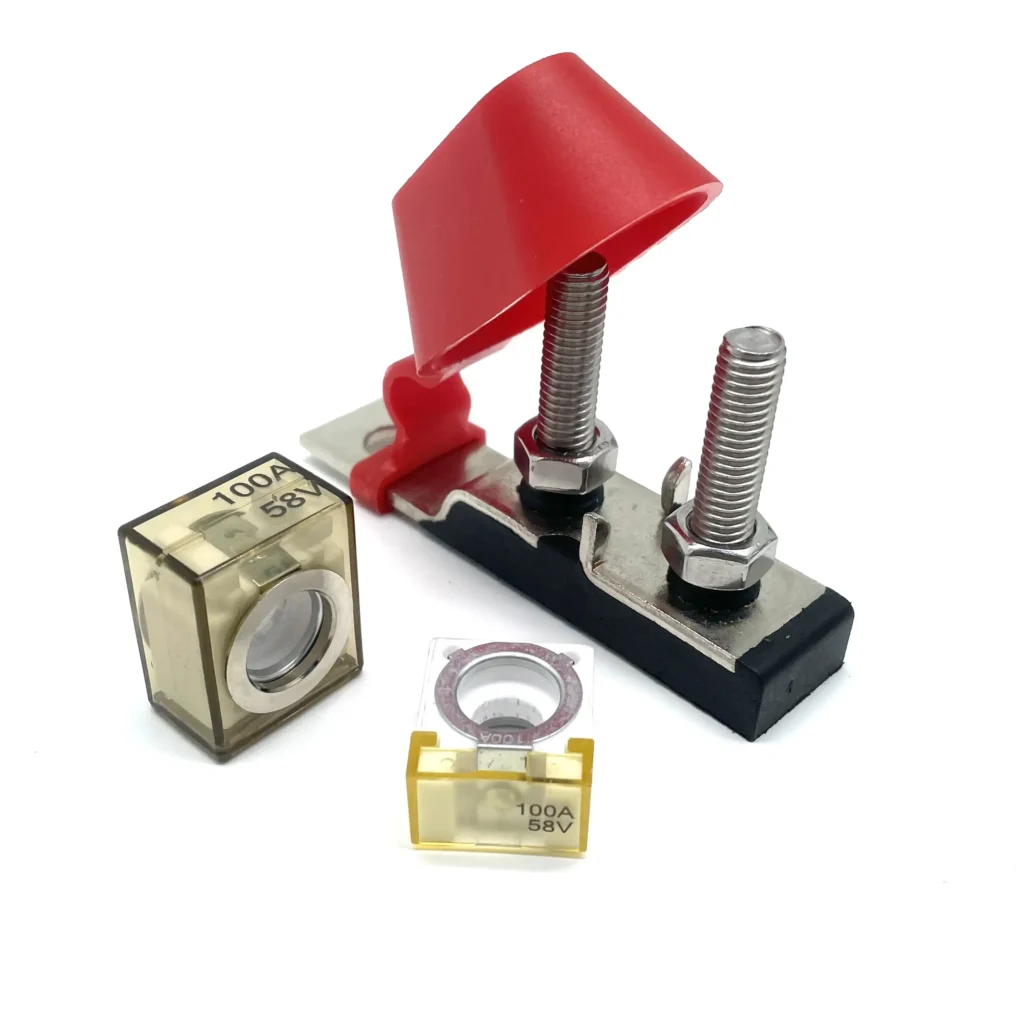
A dual MRBF fuse holder contains two separate fuse positions.
This makes it possible to divide one power source into two separately protected branch circuits without installing two completely separate holder assemblies.
For example, one branch could feed an inverter while another supplies an auxiliary DC distribution circuit.
Each branch can use an appropriately selected fuse for that circuit.
This configuration can reduce component count and simplify battery-side power distribution when two high-current branches originate from the same general location.
Does a Dual MRBF Fuse Holder Carry Twice the Current?
No. A second fuse position should not automatically be interpreted as twice the holder current capacity.
This is one of the most important distinctions when comparing single and dual holders.
A dual holder has:
two fuse positions
but that does not automatically mean:
maximum holder current × 2.
The thermal and electrical limits of the shared conductive structure still matter.
For the Cozy CZY-FH05 Dual MRBF Fuse Holder, the confirmed specification is:
Maximum total application current: 300A
That means the 300A value applies to the complete dual holder, not 300A for each branch and not 600A total.
This distinction is particularly important when two relatively large loads operate simultaneously.
Single vs Dual: Which One Should You Choose?
The easiest way to decide is to start with the number of independently protected branch circuits.
Choose a Single MRBF Fuse Holder When:
You have one high-current branch requiring fuse protection.
Examples include:
- battery to inverter;
- battery to auxiliary distribution block;
- one high-current DC accessory;
- one dedicated protected feed.
A single holder generally gives the cleanest layout when there is no need for a second protected branch.
Choose a Dual MRBF Fuse Holder When:
Two independent circuits originate from the same battery or distribution location and each requires its own fuse.
For example:
Battery
   │
Dual MRBF Fuse Holder
   ├── Fuse 1 → Inverter
   │
   └── Fuse 2 → Auxiliary Distribution
This can provide a more compact installation than using two individual holders.
Compare the Entire Electrical System, Not Just the Holder
A fuse holder should never be selected only because its maximum current number appears sufficient.
The complete protection system should be evaluated in this order:
Load → Conductor → Fuse → Fuse Holder → Fault / Breaking-Capacity Requirement
Each part answers a different question.
Load Current
Determine the normal operating current and any relevant temporary or peak current.
Conductor Size
The conductor must be appropriate for the current, installation environment, temperature and cable-routing conditions.
Fuse Rating
The fuse should protect the conductor and circuit rather than simply matching the largest fuse that fits the holder.
Holder Capability
The holder must be suitable for the system voltage, expected current and selected fuse configuration.
Fault-Current Capability
Fuse interrupting or breaking capacity is a separate specification from continuous current rating.
As an industry standards reference, ISO 8820-6:2019 defines requirements for certain road-vehicle single-bolt fuse-links rated at 58V, ≤300A and 2,000A breaking capacity for nominal 12V, 24V and/or 48V systems. This does not mean every MRBF fuse or Cozy holder is certified to ISO 8820-6; the standard is cited here only as relevant technical background.
Why Connection Quality Matters in High-Current Fuse Holders
Current rating is not the only factor that determines whether a high-current connection performs reliably.
MRBF-style installations use bolted electrical connections, so the electrical interface between the fuse, conductive plate, terminal and fastener is important.
A 2026 experimental study published in the Journal of Energy Storage investigated bolted power-battery electrical connections and found that electrical contact resistance is affected by factors including:
- bolt pre-tightening;
- contact area;
- surface condition;
- vibration.
Higher contact resistance can contribute to localized heating and energy loss in high-current electrical connections.
This is why correct assembly matters even when the holder and fuse are properly rated.
External link anchor:research on bolted battery electrical connections
2026 Journal of Energy Storage research paper
Do Single and Dual Holders Use Different Fuse Ratings?
Not necessarily.
The number of fuse positions and the fuse rating are separate decisions.
For example, a dual holder may contain two circuits with very different current requirements:
Branch A → larger load → Fuse A
Branch B → smaller load → Fuse B
The fuse for each branch should therefore be selected according to the circuit it protects.
Do not select both fuses simply because they physically fit the same holder.
Likewise, a holder capable of handling a high maximum application current does not mean the largest available fuse should automatically be installed.
Why Are MRBF Holders Often Installed Near the Battery?
Locating overcurrent protection near the power source reduces the length of conductor that remains unprotected upstream of the fuse.
This concept is particularly relevant in battery-fed systems.
For certain U.S. recreational boat applications, U.S. Coast Guard electrical-system requirements specify overcurrent protection for ungrounded battery output conductors and require the fuse or circuit breaker to be located within a defined distance from the battery, with specific exceptions such as certain engine-cranking circuits.
This regulatory example should not be interpreted as a universal installation rule for every vehicle, boat or country. The applicable electrical standard and installation requirements should always be checked for the specific application.
Installation Space Can Decide Between Single and Dual
Electrical capability is only part of the selection process.
Physical layout matters as well.
Before choosing a holder, check:
- available mounting area;
- cable direction;
- terminal lug dimensions;
- stud size;
- clearance above the holder;
- fuse replacement access;
- protective-cover clearance.
A dual holder can reduce the number of individual components, but cable routing may become more concentrated around one installation point.
A single holder may provide more flexibility when two circuits are physically separated.
Single vs Dual MRBF Fuse Holder: Cozy Options
For systems that need one protected branch, the CZY-FH04 Single MRBF Fuse Holder provides one MRBF fuse position.
For systems requiring two independently fused branches, the CZY-FH05 Dual MRBF Fuse Holder provides two fuse positions in one assembly.
CZY-FH04 Single
- 1 circuit;
- 58V DC;
- maximum application current 300A;
- M8 stud;
- PBS body;
- nickel-plated copper current-carrying plate;
- protective cover.
CZY-FH05 Dual
- 2 circuits;
- 58V DC;
- maximum total application current 300A;
- two MRBF fuse positions;
- M8 studs;
- PBS body;
- nickel-plated copper conductive components;
- protective cover.
Frequently Asked Questions
Is a dual MRBF fuse holder better than a single holder?
Not automatically. A dual holder is useful when two independent circuits require fuse protection. A single holder is usually more appropriate when only one circuit needs protection.
Can a dual MRBF fuse holder use two different fuse ratings?
Potentially yes, provided each fuse is compatible with the holder and correctly selected for its individual circuit. The total electrical limits of the holder must still be respected.
Does a dual MRBF fuse holder provide twice the current capacity?
No. The number of fuse positions does not by itself determine total current capacity. Always check the complete holder specification.
For Cozy CZY-FH05, the specified maximum total application current is 300A.
Is a 300A fuse correct just because the holder supports up to 300A?
No. The fuse rating should be selected according to the protected conductor, load characteristics, circuit requirements and applicable standards.
What can cause an MRBF fuse holder connection to heat up?
Possible contributors include excessive current, insufficient contact pressure, poor terminal contact, contamination, vibration, conductor or connection issues, and increased contact resistance. Research on bolted battery connections shows that preload, contact area, surface condition and vibration can materially affect electrical contact resistance.
Should an MRBF fuse holder be installed directly beside the battery?
Battery-side installation is common because overcurrent protection is most effective when the unprotected conductor length is controlled. Exact placement requirements depend on the application and applicable electrical standard.
Final Selection Checklist
Before deciding between a single and dual MRBF fuse holder, confirm:
- How many circuits require independent protection?
- What is the system voltage?
- What current does each branch carry?
- What conductor size is used?
- What fuse rating does each conductor and load require?
- What is the holder’s total current limit?
- Is the fuse compatible with the holder?
- Are the stud and cable lug dimensions compatible?
- Is there enough installation and service clearance?
- What environmental protection is required?
If you only need to protect one circuit, a single MRBF fuse holder is generally the simpler solution.
If two independent circuits originate from the same power-distribution point, a dual MRBF fuse holder can provide a compact two-branch solution—as long as the total holder current limit and the requirements of each individual circuit are correctly evaluated.
When choosing between a single vs dual MRBF fuse holder, start with the number of circuits that require independent protection, then verify the electrical and installation requirements of the complete system.