
Choosing the correct automotive fuse amperage is not a matter of picking the largest fuse that fits the holder. A fuse is part of the circuit-protection design, so the rating must be compatible with the circuit, wiring, load behavior and fuse format.
One of the most common mistakes in aftermarket vehicle wiring is increasing the fuse rating after a fuse opens repeatedly. That can hide the symptom without addressing the cause. The better approach is to confirm the intended circuit rating and diagnose why the original protection operated.
Quick Answer
To choose automotive fuse amperage, verify the vehicle or equipment specification first. Then confirm that the selected fuse protects the wiring and is compatible with the load, holder, voltage and fuse family. Do not choose the rating from body color or wire gauge alone.
What Does a Fuse Amp Rating Mean?
The amp rating identifies the fuse’s rated current, but actual fuse behavior is defined by more than one number. Time-current performance matters because a fuse does not necessarily open instantly at every value above its rating.
That is why standards use defined test conditions. SAE J1284 addresses blade-type electric fuses used to protect wiring and equipment in motor vehicles, boats and trailers, while ISO 8820-3:2026 defines rated-current and performance requirements for several road-vehicle blade fuse types within its scope.
Step 1: Start With the Circuit Specification
For an OEM vehicle circuit, use the fuse value specified by the vehicle manufacturer, wiring diagram or service documentation. For a new OEM/ODM circuit, the fuse selection should come from the electrical design rather than from a generic chart.
If the original circuit uses a 15A fuse, replacing it with a 20A fuse simply because the 15A unit keeps opening is not a valid diagnostic method.
Step 2: Remember That the Fuse Protects the Circuit
A fuse is often described as protecting the load, but from a wiring-design perspective its key job is to interrupt excessive current before the protected conductors and components are exposed to an unacceptable condition.
Do not size the fuse from advertised equipment wattage alone. Conductor material, cross-sectional area, insulation temperature rating, ambient temperature, bundling, installation method, connector limits and circuit length can all matter.
Step 3: Confirm the Load Behavior
Some loads have temporary inrush current during startup. Motors, compressors and some electronic equipment can draw more current briefly than during steady operation. This is one reason the correct fuse is not selected by a simple “load current equals fuse current” rule.
Use the equipment manufacturer’s required protection specification or an engineered circuit design.
Step 4: Match the Fuse Format
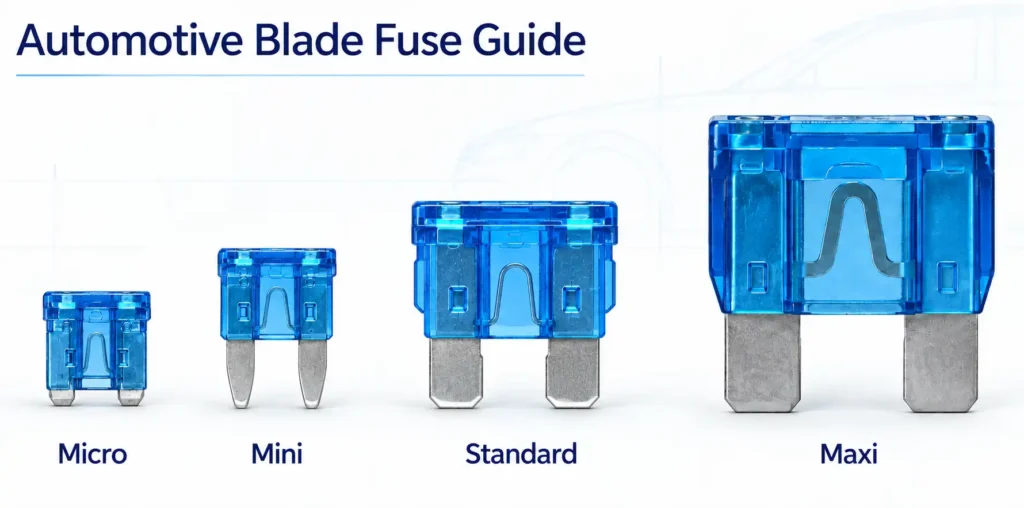
After the electrical rating is known, confirm whether the application requires Micro, Mini, Standard, Maxi or another fuse family. Read our automotive blade fuse guide if you need to identify the physical format first.
Cozy Electronics offers multiple automotive fuse formats for different vehicle circuit requirements.
Step 5: Check the Voltage Rating
Amp rating and voltage rating are separate. A fuse should only be used within its specified voltage application. Do not assume a fuse is suitable for a 48V system because the current rating matches a fuse used in a 12V system.
Why Wire Gauge Alone Is Not Enough
Online discussions often reduce fuse sizing to a wire-gauge table. Those charts can be useful as a starting point, but they are not a complete design method. Two wires with the same nominal gauge can have different conductor materials, insulation systems, installation temperatures or permissible current ratings.
For B2B sourcing, ask for the harness or cable specification together with the fuse and holder requirements instead of approving a fuse rating in isolation.
What If the Fuse Keeps Blowing?
Do not move directly to a higher rating. Repeated fuse operation can indicate an overload, short circuit, damaged component, incorrect fuse choice or another fault. See our guide on why a car fuse keeps blowing before changing the protection value.
Fuse Amperage Selection Checklist
| Check | Question |
|---|---|
| Circuit requirement | What rating does the vehicle or equipment specification call for? |
| Wire protection | Is the protective device compatible with the conductor and installation? |
| Load behavior | Does the load have startup or transient current? |
| Fuse family | Does the fuse physically match the holder? |
| Voltage | Is the fuse rated for the system voltage? |
| Failure history | If the fuse opened, has the cause been diagnosed? |
Frequently Asked Questions
Should the fuse rating equal the normal load current?
Not necessarily. Fuse selection depends on the circuit design and time-current behavior, not only the normal steady-state load.
Can I use a larger fuse if the correct fuse blows often?
Do not increase the fuse rating without confirming the circuit design and finding the cause of repeated operation.
Does wire gauge determine the fuse size?
Wire size is an important factor, but it is not the only one. Conductor material, insulation, temperature, installation and connected components also matter.
Conclusion
Correct automotive fuse amperage is an engineering decision, not a color-matching exercise. Start with the specified circuit requirement, confirm conductor and component limits, then select the correct fuse family and voltage rating.